
RightSite Blog · Road Test Guide
10 Common Mistakes That Make People Fail Their G2 Road Test in Ontario (2026)
Last updated: September 4, 2026 · RightSite Driving School, Wasaga Beach
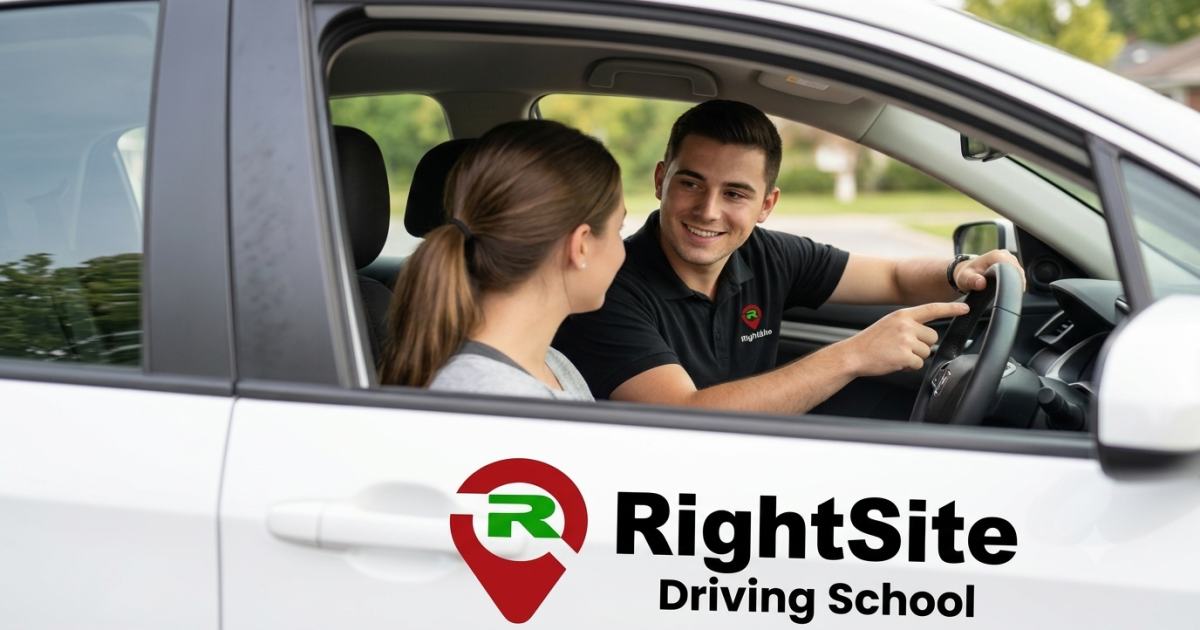
Most people who fail a G2 road test can drive. That is the frustrating part. They get to the test centre knowing how to steer, brake and park, and they still come back with a scoresheet full of marks against them. The reason is almost always the same: the examiner is not grading whether you can drive, but whether you show them you are driving safely — every mirror check, every shoulder check, every full stop, every time. Small habits you get away with on a quiet Sunday drive with a parent beside you are the exact things that cost you the test.
What are the most common reasons people fail their G2?
Here is the short version, based on what driving instructors correct over and over:
- 01 Not checking mirrors often enough, or checking them too late
- 02 Skipping the shoulder check on blind spots
- 03 Lane changes without the proper signal, mirror and shoulder-check sequence
- 04 Rolling through stop signs instead of coming to a full stop
- 05 Driving too slowly, or drifting over the limit without noticing
- 06 Not yielding properly at intersections, crosswalks and roundabouts
- 07 Turning from the wrong lane, or ending up in the wrong lane
- 08 Following the car ahead too closely
- 09 Parallel parking and reversing done without observation
- 10 Turning up unprepared — wrong paperwork, unchecked car, or nerves that were never practised for
None of these are hard skills. They are habits, and habits can be fixed in a few focused lessons.
First, what the G2 test actually is
DriveTest describes the Class G2 road test as a check of basic driving skills. It is commonly called the “city test” and usually takes about 20 minutes. There is no highway driving in it — that comes at the full G test later.
The Official MTO Driver’s Handbook lists what the Level One (G1 exit) road test looks at:
- ✓ Starting, stopping and turning
- ✓ Traffic signs and lights
- ✓ Passing vehicles, including bicycles, and driving in passing lanes
- ✓ Travelling through controlled and uncontrolled intersections
- ✓ Parallel parking and reversing
- ✓ Foreseeing hazardous conditions and being ready for them
- ✓ Other safe driving practices
Everything below falls under one of those lines. That is why they matter.
1. Not doing proper observations and mirror checks
What it looks like: Your eyes stay locked on the car ahead. You only look at the mirrors when you are about to do something, instead of already knowing what is behind you.
Why it costs you: Observation marks add up faster than anything else on the scoresheet, and an examiner cannot give you credit for looking if they never see you look.
What the examiner is looking for: Steady scanning. The MTO handbook says to check your mirrors about every five seconds.
How to fix it: For a week, say it out loud as you drive — “rear mirror, right mirror, speedometer” — until the pattern runs on its own. Move your eyes, not just your gaze.
Simple tip: Check your rear mirror once at every intersection you approach. It gives your scanning a rhythm.
2. Skipping the blind spot check
What it looks like: Mirror check, signal, move. No shoulder check — or one so small it is really a glance at the door pillar.
Why it costs you: This is the single most common thing instructors have to correct. Mirrors do not cover the blind spot, and the examiner knows it.
What the examiner is looking for: A real head turn over your shoulder before you move sideways: lane changes, pulling out from a curb, merging, and turns where a cyclist could be beside you.
How to fix it: Turn your head far enough that the examiner sees your ear, and do it before you touch the wheel rather than while you are already moving.
Simple tip: Mirror, signal, shoulder, move. If the car changes position on the road, your head moves first.
3. Improper lane changes
What it looks like: Signalling and moving in the same second. Changing lanes across a solid line. Cutting back in too close. Forgetting to cancel the signal afterwards.
Why it costs you: A lane change touches several graded skills at once — observation, signalling, positioning, and judgement of space.
What the examiner is looking for: A signal early enough for traffic behind to understand you, a mirror check and a shoulder check, a smooth move at steady speed, and a full car length of space left before you settle in.
How to fix it: Slow the sequence down. Signal, count “one thousand and one,” check mirror and blind spot, then move. Never change lanes inside an intersection.
Simple tip: Signal first, then look, then steer. Three separate actions, never one.
4. Rolling through stop signs
What it looks like: The car slows to walking pace at the line, the driver looks both ways and keeps creeping. The wheels never actually stop.
Why it costs you: It is easy to spot from the passenger seat and it is not a judgement call. A stop either happened or it did not.
What the examiner is looking for: A complete stop at the stop line — or before the crosswalk or edge of the intersection where there is no line — then a proper look left, right, and left again.
How to fix it: Stop, feel the car settle back on its springs, count one second, then look. Wasaga Beach and Stayner have plenty of quiet four-way stops to drill this without holding anyone up.
Simple tip: Stop, rock, count, go.
5. Poor speed control
What it looks like: Creeping up to 60 in a 50 zone without noticing. Or the opposite — driving 35 in a 50 zone because you are nervous, with a line of traffic behind you.
Why it costs you: Both directions are marked. Driving too slowly reads as a lack of control and can create a hazard.
What the examiner is looking for: Speed that matches the posted limit and the conditions, changed smoothly rather than in surges. Where nothing is posted, the MTO handbook sets the maximum at 50 km/h in cities, towns and villages, and 80 km/h elsewhere.
How to fix it: Learn where the signs are on the roads around your test centre and glance at the speedometer every few seconds. Around Wasaga Beach, watch the drop into residential streets off Mosley Street and River Road West.
Simple tip: If you cannot say the limit out loud, you are guessing.
6. Not yielding properly
What it looks like: Edging into a left turn when the gap is not really there. Not stopping for someone waiting at a crosswalk. Going out of turn at a four-way stop. Entering a roundabout without giving way to traffic already in it.
Why it costs you: Right-of-way errors are safety errors, and this is the category most likely to end a test early.
What the examiner is looking for: That you know who goes first, and that you go without hesitating when it is clearly your turn.
How to fix it: Practise what you find hardest, not what you already enjoy. Unprotected left turns and roundabouts catch most students here, and there are roundabouts around Wasaga Beach and Collingwood that make good practice.
Simple tip: When you are unsure, yield. A cautious wait costs far less than a wrong assumption.
7. Turning incorrectly
What it looks like: A right turn taken wide into the far lane. A left turn that cuts the corner. Turning from the wrong lane. Signalling too late for the driver behind.
Why it costs you: Turns are the most repeated manoeuvre on the test. Sloppy turns pile up marks in 20 minutes.
What the examiner is looking for: The correct lane before the turn, a signal on in good time, a look through the turn, and finishing in the correct lane — right turns into the right lane, left turns into the nearest left lane.
How to fix it: Set up early. Choose your lane at least half a block back so the turn is a steering job, not a decision.
Simple tip: Right lane to right lane, left lane to left lane. Finish where you started.
8. Poor following distance
What it looks like: Sitting close behind the car ahead, then braking hard when it slows.
Why it costs you: It tells the examiner you are reacting rather than planning, and it is easy for them to measure.
What the examiner is looking for: The two-second rule. The MTO handbook says a safe following distance is at least two seconds behind the vehicle in front of you — more in rain, snow, or poor visibility.
How to fix it: Pick a marker like a sign or pole. When the car ahead passes it, count “one thousand and one, one thousand and two.” If you reach the marker first, back off. Stopped in traffic, leave enough room to see the rear tires of the car ahead touching the road.
Simple tip: Two seconds in good weather, four on a wet Highway 26 morning.
9. Parking mistakes
What it looks like: Reversing while only looking in the mirror. Parallel parking a metre off the curb. Hitting the curb hard. Rushing because it feels embarrassing.
Why it costs you: Parallel parking and reversing are named directly in the handbook’s list of what the road test covers, and your observation during the manoeuvre is graded — not just the final position.
What the examiner is looking for: Looking before and while you reverse, including over your shoulder through the rear window. Slow, controlled movement. A finish reasonably close and parallel to the curb.
How to fix it: Speed is not the goal, and correcting yourself is allowed. Practise on a real street with real curbs, not an empty lot — the quieter residential blocks off Hurontario Street in Collingwood work well.
Simple tip: Eyes back, foot light. If you are only looking at the mirror, you are being marked.
10. Turning up unprepared
What it looks like: Arriving with ten minutes to spare. A brake light nobody checked. A cracked windshield. A friend in the back seat. Not knowing which building the test runs out of.
Why it costs you: This one can end your test before you have driven a metre. DriveTest can cancel a road test at the vehicle check, and you lose 50% of the fee.
What the examiner is looking for: A vehicle in safe working order and a driver who is settled instead of scrambling.
How to fix it: Work through the checklist below the night before, not the morning of. And treat nerves as something to practise — do at least one full practice run that copies the real thing: same time of day, same roads, no talking.
Simple tip: The test starts in the parking lot, not on the road.
What examiners are looking for
Strip it all back and the examiner is watching for a handful of behaviours, repeated consistently for about 20 minutes:
- 01 Observation you can see. Mirrors, shoulder checks, and looking through intersections and turns.
- 02 Full stops. At stop signs, at stop lines, and at a red light before a right turn.
- 03 Space. Following distance, room when you pass cyclists, room when you pull back in after a lane change.
- 04 Correct positioning. The right lane before the turn, and the right lane after it.
- 05 Smooth control. Gradual braking and steady acceleration rather than jerky corrections.
- 06 Rules applied without prompting. Signals, speed limits and right-of-way handled without the examiner saying anything.
Nobody drives a flawless test, and you are allowed small errors. What you cannot do is repeat the same one all the way round the route.
5 things to practise the week before your G2
- 01 Shoulder checks, every single time. For one full week, do not change lane position without a head turn.
- 02 Ten full stops a day. Find quiet four-way stops in Wasaga Beach or Stayner and drill stop–rock–count–go.
- 03 Parallel parking and reversing on a real street. Curbs, traffic, driveways — not an empty parking lot.
- 04 Left turns and roundabouts. The two things students most often avoid, so practise them deliberately.
- 05 One full dress rehearsal. Same time of day as your test, on the roads around your test centre, with no music and no chat.
If you can only do one, make it the last one. Familiar roads take a surprising amount of the nerves out of test day.
G2 road test day checklist
Straight from DriveTest’s own road test guidance:
- ✓ Your current driver’s licence
- ✓ A printout of your road test confirmation email
- ✓ Glasses or contact lenses if you need them to drive — a missing corrective lens can cancel the test
- ✓ Enough fuel to complete the test
- ✓ Arrive at least 30 minutes early: park, check in inside the centre, then wait in your vehicle for the examiner
- ✓ No passengers and no pets in the car
- ✓ Recording devices off — dashcams and similar must not be enabled during the test
And the vehicle itself. According to DriveTest’s road test vehicle requirements, any of these can get your test cancelled — with a loss of 50% of the fee:
- × A non-working brake light, turn signal, headlight or tail light
- × A non-working horn or speedometer
- × A damaged windshield with large cracks or stars
- × A flat tire, a temporary spare on any wheel, or defective tires
- × A missing or unsecured licence plate, a missing mirror, or no rear bumper
- × Non-working wipers, no washer fluid, or a non-working defroster when the weather calls for them
- × A missing or non-working seat belt for you or the examiner
Add the two things the official list does not mention: sleep, and a proper breakfast. A tired driver misses observations.
What if you fail your G2?
Failing is not the end of anything. You keep your G1 and you can book another test. Two things to know: DriveTest says you generally have to wait at least 10 days between road tests, and you pay the road test fee again — currently listed at $53.75. Fees and rules change, so check drivetest.ca before you rebook.
The most useful thing you get back is the scoresheet. It shows where the marks came from. Take it to an instructor, work on those specific items, and rebook once they are fixed — not before. Booking again a week later without changing anything usually produces the same result. Our guide to the G2 road test in Collingwood covers the booking side in more detail.
Taking your G2 test near Wasaga Beach
Wasaga Beach does not have a DriveTest centre. Local students normally test in Collingwood, where road tests run from a travel point operated out of the Barrie centre, hosted inside the ServiceOntario office at 191 Hurontario Street, Unit 6, Collingwood. DriveTest lists road tests there as G2 and G, on selected days — generally Tuesdays and Wednesdays, with some Thursdays. If you also need a G1 knowledge test, check what is available at that counter or at the full DriveTest centres in Barrie and Owen Sound. Services and days do change, so confirm on DriveTest’s centre list before you book.
If Collingwood has nothing in your timeframe, Barrie and Owen Sound are the nearest full centres. Just remember you would be tested on roads you have never driven, so give yourself time to practise there.
RightSite Driving School is based in Wasaga Beach and works with students across Wasaga Beach, Collingwood, Stayner and the surrounding area, including practice on the roads around the Collingwood test centre.
Need help preparing for your G2?
If you have read this far and recognised two or three of your own habits, that is exactly what a lesson is for. An instructor sitting beside you will spot in ten minutes what you cannot see yourself — the shoulder check you think you are doing, the stop that is really a roll.
RightSite Driving School offers road test preparation and individual lessons for students in Wasaga Beach, Collingwood and Stayner. Lessons are $50 + HST for 60 minutes in a dual-brake car with pickup and drop-off in Wasaga Beach, and you can spend the time on whatever is weakest — parallel parking, left turns, or a full mock test on the roads around the Collingwood test centre. If you do not have a car for the test, we rent one with an instructor drop-off and a warm-up drive: $149 + HST in Collingwood, $220 + HST at other Ontario test centres.
Not sure you’re ready for your G2? Book a lesson with RightSite Driving School and get professional feedback before test day. You can also call or text 416-402-4492, or use the individual lesson enrollment form.
If you have not started your licence yet, our Beginner Driver Education course covers the full MTO curriculum and reduces the time you spend at G1 by four months. We have also written a full breakdown of what a BDE course costs in Ontario. And if you are comparing schools on price alone, it is worth reading what a cheap lesson really costs.
Frequently asked questions
What is the most common reason people fail the G2 road test?
Observation errors. Missed shoulder checks and infrequent mirror checks are what driving instructors correct most often, because examiners can only credit what they see you do.
How long is the Ontario G2 road test?
DriveTest says the Class G2 road test usually takes about 20 minutes. It is a city test — no highway driving is included at the G2 level.
Is parallel parking on the G2 test in Ontario?
Parallel parking and reversing are listed in the Official MTO Driver’s Handbook as part of what the Level One road test covers. Practise both, and expect to be graded on your observation while doing them.
How long do I have to wait to retake my G2 road test?
DriveTest states that you generally must wait at least 10 days between road tests. You will pay the road test fee again for each attempt.
How much does the G2 road test cost in Ontario?
DriveTest lists the Class G2 road test at $53.75. Check drivetest.ca for the current fee before you book, since fees change.
How long do I have to hold my G1 before the G2 test?
Twelve months, or eight months if you complete an approved Beginner Driver Education course, which reduces your Level One time by four months.
Is there a DriveTest centre in Wasaga Beach?
No. Wasaga Beach has no DriveTest centre. Road tests for local students usually run from the Collingwood travel point inside the ServiceOntario office at 191 Hurontario Street, Unit 6, which DriveTest lists for G2 and G road tests.
Can I use a driving school car for my G2 road test?
Yes. RightSite Driving School rents an insured, dual-brake vehicle for the road test — $149 + HST in Collingwood and $220 + HST at other Ontario test centres, including a warm-up drive before the test.
Sources: DriveTest — Road Tests, Road Test Vehicle Requirements, Fees, and the Official MTO Driver’s Handbook. Rules and fees change — always confirm current requirements with DriveTest before your test.