
G1 rules · Accompanying drivers
Just Got Your G? Here's Why You Probably Can't Teach Your Brother or Sister Yet
Passing your G test doesn't, by itself, let you sit beside a G1 driver. Ontario has a four-year rule, and getting it wrong can mean a charge for the learner and a messy insurance claim for the family.
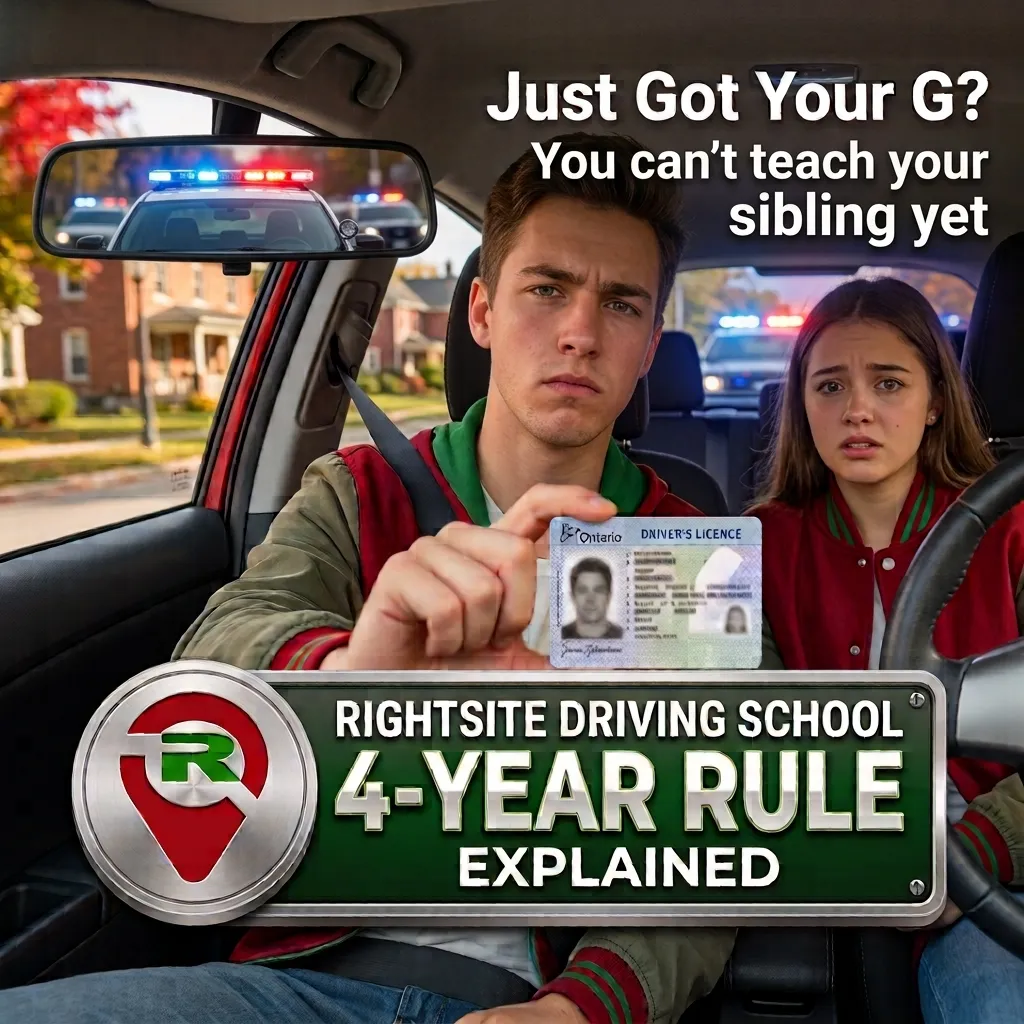
A young man called our office not long ago, and you could hear the smile in his voice. He'd passed his G test that morning. His question wasn't about insurance or buying a car. It was this:
"I got my full G today. Can I take my brother out to practise now? He just got his G1."
It's a kind thought. Lessons cost money, parents are busy, and an older brother who just passed seems like the perfect coach. We get some version of this call every few weeks, usually from someone who's still excited from their road test.
For most people in his spot, the honest answer is not yet. Here's what the law actually says, how to check where you stand, and what can go wrong if you guess.
What the law says about accompanying drivers
When someone drives on a G1, they can't drive alone. A qualified person has to sit in the front passenger seat. Ontario calls that person the accompanying driver.
The rule is in Ontario Regulation 340/94, section 5(2). It says a person qualifies to be an accompanying driver if they:
- are a fully licensed Class G driver,
- have been licensed in Ontario or another jurisdiction for at least four years, and
- meet the conditions of their own licence, such as wearing glasses if required.
The Official MTO Driver's Handbook puts it simply: the accompanying driver must have a valid Class G (or higher) licence, at least four years of driving experience, and a blood-alcohol level under .05%.
Notice that these are two separate tests. You need a full G today, and you need four years of licensed driving behind you. Passing the G test takes care of the first one. It doesn't automatically take care of the second.
"I always heard it was four years of full G." Not quite.
This is one of the most common mix-ups we hear, including from parents. The rule isn't four years at the G level. The handbook says it directly: time spent at the Class G2 level counts toward the four years, as long as the G2 licence was valid and not suspended.
So getting your G doesn't restart a clock. Your G2 time is already counting.
What about G1 time? The handbook confirms G2 time but doesn't clearly say the same for G1 months. If you need your G1 time to reach four years, don't guess. Confirm it with ServiceOntario or the Ministry before you take anyone out.
Where does that leave someone who just passed?
It depends on your own licence history, so do the maths for yourself. Here's an example.
Say you took a Beginner Driver Education (BDE) course and moved through as fast as the rules allow. That's about 8 months on your G1, then at least 12 months on your G2 before the G test. If you passed the G on your first try, you'd have roughly one year of G2 time on your record. You'd still be about three years short of four years of G2 and G time combined.
Now say you sat on your G2 for four years before booking the G test. Your G2 time counts, so you could qualify the day you pass. Everyone's path is different. That's why the date on your plastic card isn't enough to go on.
Other rules the person beside the learner has to follow
Qualifying is the first step. During every practice drive, the accompanying driver also has to:
- Be the only other person in the front seat. Other passengers go in the back, and only as many as there are working seatbelts.
- Keep their blood alcohol under .05. Ontario's G1 page adds that if the accompanying driver is 21 or under, their level should be zero. Honestly, the simplest plan is no alcohol at all before a practice drive.
And the learner's own G1 limits still apply, even with a perfect accompanying driver:
- Blood alcohol of zero.
- No driving between midnight and 5 a.m.
- No 400-series highways with a speed limit over 80 km/h, and no high-speed roads like the QEW, Don Valley Parkway or Gardiner. The only exception is when the accompanying driver is a licensed driving instructor.
That last one surprises families. A parent with 30 years of driving still can't take a G1 learner on Highway 400. Plan your route before you leave, because a map app may send you onto a highway the learner isn't allowed on.
One more piece of history: before August 1, 2010, licensed driving instructors were exempt from the four-year rule. That exemption was removed. Today instructors need four years too.
What can happen if you get pulled over
Picture a Saturday afternoon on Highway 26 near Stayner. Your sister is driving on her G1. You're beside her with your brand-new G and about a year of G2 time. An officer stops you for a burnt-out tail light and checks both licences.
Here's what's at stake:
- The learner can be charged. Under section 57.2 of the Highway Traffic Act, a novice driver who breaks a condition of their licence commits an offence. Driving without a qualified accompanying driver is one of those conditions. The law does give the learner a defence if they took all reasonable steps to make sure the accompanying driver qualified, so a quick check beforehand matters.
- A conviction can mean a suspension. Ontario's escalating sanctions for novice drivers generally mean a 30-day suspension for a first conviction, 90 days for a second within five years, and a cancelled licence for a third, which means starting over at G1.
- Plans get pushed back. A suspension can throw off road test bookings and the learner's whole timeline.
None of that needs a crash. A tail light is enough.
What can happen if there's a crash
This is the part nobody thinks about when they're trying to save a few lesson fees.
Insurance. Ontario's standard auto policy includes a condition that the person driving must be authorized by law to drive. A G1 driver without a qualified accompanying driver may not meet that condition. Whether a particular claim gets paid depends on the facts and the policy, but it can become a serious problem. In a 2023 Ontario Court of Appeal case, Pridmore v. Drenth, a G1 driver who broke his licence conditions ended up without insurance coverage for a crash in which his passenger was badly hurt.
The car's owner. Under section 192 of the Highway Traffic Act, the owner of a car can be held responsible for damage caused by negligent driving when the car is being driven with their permission. The driver and owner can be held responsible together. In a lot of families, the owner is Mom or Dad.
Premiums. An at-fault claim usually raises insurance costs, and it can stay on the household's record for years.
If someone is seriously injured, the money involved can be far larger than the cost of a few professional lessons. If you're unsure how your own policy treats a G1 driver, call your insurance broker before the first practice drive, not after.
"I'm not charging them. I'm just helping."
Not taking money doesn't change the accompanying driver rule. You still need to qualify.
And if you do want to charge people, that's a different line. Section 58 of the Highway Traffic Act says a person needs a driving instructor licence to give driving instruction for money. A full G and four years of driving don't make someone an instructor.
How to help a new driver right now
You can still be a big help without sitting in the front seat yet.
- Help them study. Quiz them on signs and rules, or send them our free Ontario G1 practice test.
- Ride in the back. If a qualified driver is in the front, you can come along in the back seat and share what you learned on your road tests.
- Tell them what test day is really like. You just did it. Which roads around Collingwood or Wasaga Beach caught you off guard? What did the examiner watch for?
- Find a qualified driver. Usually a parent, aunt, uncle or family friend with a full G and at least four years of licensed driving.
- Book a few professional lessons. A licensed instructor teaches in a car with a dual brake, can take a G1 learner on highways a family member can't, and knows what DriveTest looks for.
When you do qualify: how to make practice useful
Once you meet the rule, here's how to be the kind of accompanying driver who actually helps. DriveTest's own advice is to be a clear communicator and to pick routes that match the learner's skill level. In our experience, that's exactly where most family practice goes wrong.
- Pick one skill per drive. Smooth stops. Checking blind spots before turns. Judging a safe gap. Not all of it at once.
- Give directions early. "Turn right at the next street" gives them time to prepare. "Turn here!" at the corner just creates panic. If they miss a turn, carry on and reroute.
- Keep talk short while moving. Save the long explanations for when you're parked.
- Build up slowly. Quiet streets in Wasaga Beach before downtown Collingwood. Dry daylight before rain, dusk or snow.
- End with two questions: "What felt easier today?" and "What should we practise next time?"
A 30-second check before every practice drive
Common questions about the four-year rule
Does my G2 time count toward the four years?
Yes. The MTO Driver's Handbook says time at the Class G2 level counts toward the accompanying driver's four years, as long as the G2 licence was valid and not suspended.
Does my G1 time count?
The handbook doesn't clearly say. If you need your G1 months to reach four years, confirm with ServiceOntario or the Ministry of Transportation before acting as an accompanying driver.
Can someone with a G2 sit beside a G1 driver?
No. The accompanying driver must be fully licensed in Class G (or higher), even if they've held their G2 for years.
I drove for years in another country. Does that count?
The regulation counts years licensed in Ontario or another jurisdiction, so your history from another country may count. Check with ServiceOntario how your record was transferred before you rely on it.
The bottom line
Getting your G is a big moment, and wanting to share it with your family says a lot about you. Just check the four-year rule before you climb into the passenger seat. A few minutes confirming your licence history can save your sibling a suspension and save your family a lot of stress and money.
Until then, we're happy to help. RightSite Driving School is an MTO-approved Beginner Driver Education course provider in Wasaga Beach, teaching students from Collingwood, Stayner and the surrounding area one on one. Individual lessons are $50 + HST, and our full BDE course is $649 + HST with flexible payment plans. Call or WhatsApp us at 416-402-4492 and we'll help your brother or sister get road-ready, the right way.